How Much Manual Order Entry Actually Costs Wholesale Distributors
Manual order entry costs mid-size distributors $200K+ per year in labor alone, before errors, delays, and turnover. Here's the full breakdown.
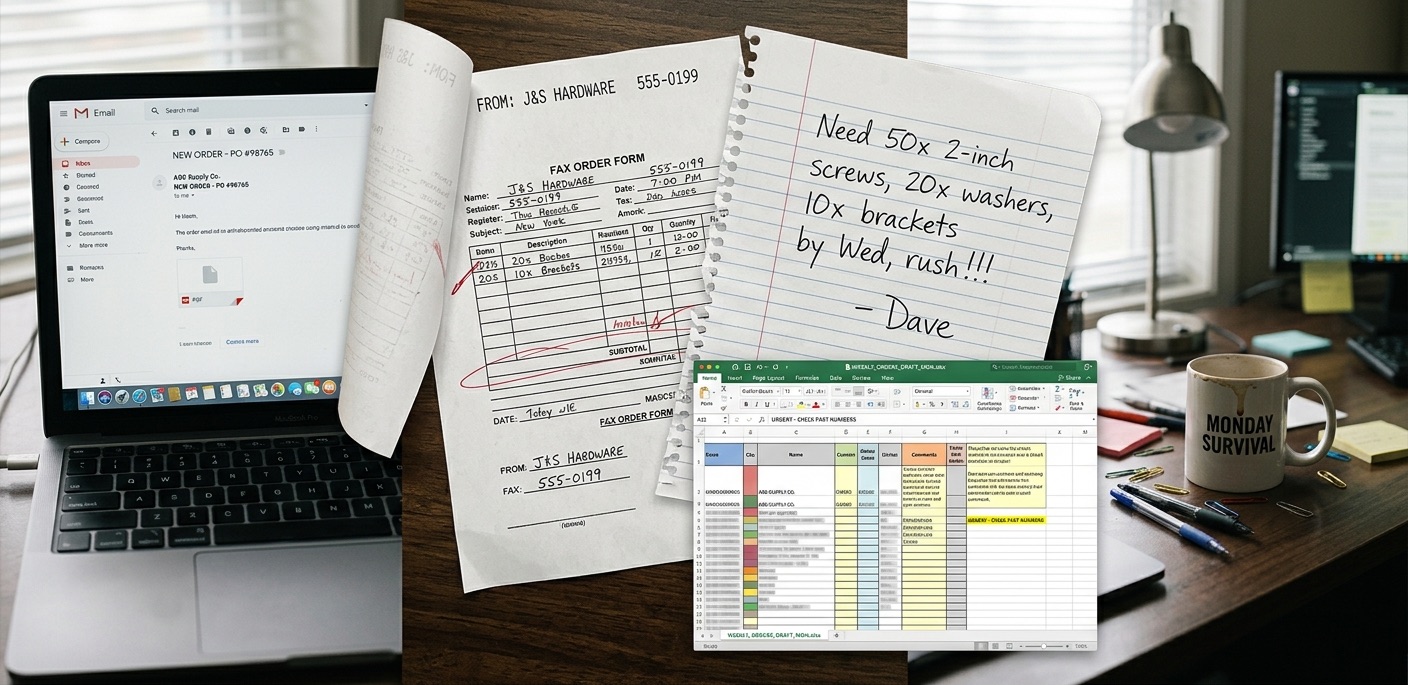
Every wholesale distributor knows what manual order processing looks like. Orders arrive as email PDFs, typed messages, phone calls, faxes, spreadsheet attachments, sometimes even a photo of a handwritten note. Someone reads each one, interprets what the customer wants, and types it into the ERP. Line by line.
Nobody tracks what it all adds up to. Let’s do the math.
What the process actually looks like
Orders don’t arrive in a clean, consistent format. One customer sends “ship me the usual” without specifying items. Another emails a spreadsheet with 85 line items and no product codes. A contractor calls with part descriptions instead of SKU numbers. A purchasing agent forwards last month’s invoice with “ship this again” message on top.
Every format requires human interpretation. A CSR (Customer Service Representative) doesn’t just type, they translate. They match customer terminology to your SKU system, verify pricing tiers, check availability, and flag anything that looks off. According to Conexiom, each order takes an average of 12 minutes of manual processing, and complex orders with dozens of line items take significantly longer.
The order processing cost
A distributor processing around 1,500 orders per month dedicates roughly 3-4 full-time employees to manual order entry, at an annual cost of approximately $225,000 ($56,000 per employee per year). Scale that to higher volumes and the numbers climb fast.
| Annual order volume | Estimated FTE equivalent | Estimated annual labor cost |
|---|---|---|
| 5,000 | 1-2 | $60K-$120K |
| 15,000 | 3-4 | $180K-$240K |
| 25,000+ | 5+ | $300K+ |
Estimates derived from Conexiom and APQC benchmarking data. Actual costs vary by order complexity, labor market, and product line.
That’s just the cost of typing things in. It doesn’t include the cost of fixing what goes wrong.
The error tax
According to APQC benchmarks, the average error rate sits at 1-3%, with some operations running as high as 7%. For a distributor processing 15,000 orders a year, that’s 150 to 1,050 orders with something wrong.
The error itself is just the beginning. What happens when a CSR types 50 instead of 500, or transposes two digits in a SKU? Wrong item ships, customer calls, CSR investigates, warehouse pulls the return, correct item picked and reshipped, credit memo issued, carrier charges both ways.
Each step involves a different person, a different system, and more time. According to a Moxo analysis of wholesale order management, the average B2B order error can cost up to $17,800 to resolve downstream - returns, reshipment, administrative time, and customer relationship damage. Even at a fraction of that figure, multiply by hundreds of incorrect orders per year and the total is significant.
The costs nobody counts
Delays and bottlenecks. Orders submitted Friday evening don’t get entered until Monday. Orders queue up during promotions or month-end. For time-sensitive industries (construction materials, medical supplies, etc.), a few hours of delay means a missed pour date or a facility without stock. Your manual order entry capacity is your throughput ceiling.
Misallocated talent. The people doing this work know your products, your customers, your edge cases. They’re spending that expertise on data transfer. Every hour retyping a PDF is an hour not spent catching a pricing error, following up on an at-risk customer, or handling orders that genuinely need judgment. Finding ways to reduce manual order entry in wholesale distribution isn’t just about cutting costs - it’s about letting these people do the work they were hired for.
Turnover. Repetitive data entry grinds people down. The CSRs who are good enough to do better eventually leave. Then you’re hiring and training again, and new hires make more mistakes while learning your catalog.
Why this stays invisible
The total order processing cost of manual entry rarely appears as a single line item:
- CSR salaries cover it, but CSRs do other things too, so it’s never isolated
- Error costs are buried in freight credits, return processing, and customer service time
- Delays surface as “customer complaints” with no root cause attributed
- Turnover gets blamed on the job market, not the work
Nobody walks into the CFO’s office and says “we’re spending $250K a year on people typing things from PDFs into our ERP”. But when distributors actually run these numbers, the total is almost always larger than expected.
If you’re doing that math for your own operation, our breakdown of what order entry automation actually looks like covers what’s realistic for mid-size distributors, and where to start.
Order intake labor isn’t the only hidden cost in the order lifecycle. Pricing errors from disconnected quoting leak another 2-12% of annual profit, and that one’s even harder to spot.